
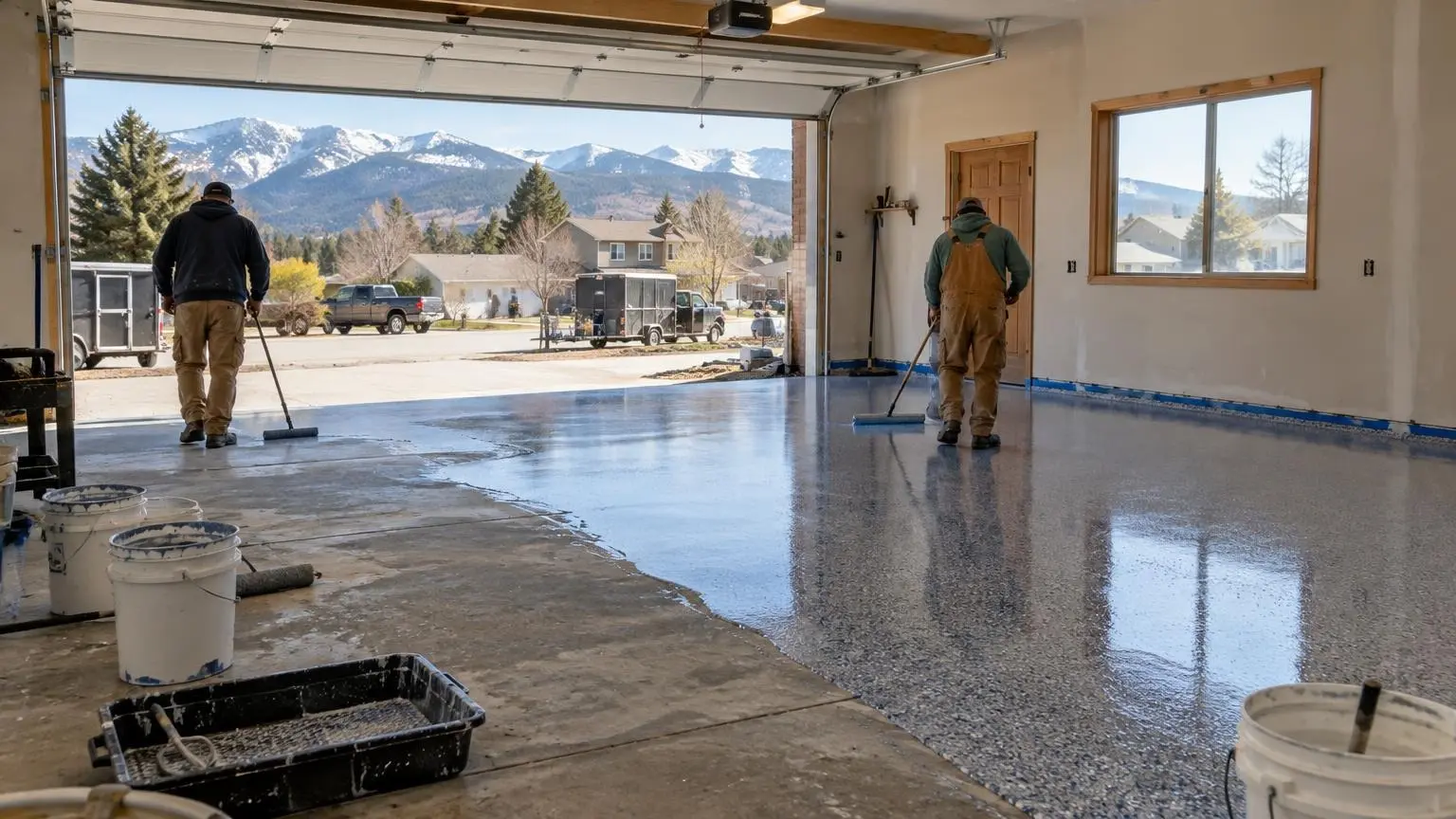
Concrete floor coatings for Western Montana
Epoxy Flooring in Missoula, MT
Garage, basement and shop floors built for sanded winter streets, deicer brine and long stretches below freezing.
- Free on-site estimate with a slab moisture check
- Itemized written quote before any work starts
- Every floor diamond ground and repaired before coating
Coatings Made for a Five-Valley Winter
Epoxy flooring in Missoula has to put up with a real Montana winter. Missoula averages about 43 inches of snow a year, and Wikipedia's climate figures show snow on the ground about 120 days a year, with roughly 45 days when the temperature never climbs above freezing. Through all of that, cars roll into the garage carrying slush, grit and road treatment. A floor coating here has to hold its bond through those months and still clean up easily in spring.
What comes into a Missoula garage on the tires
Local road crews use more than one material, and each one ends up on your floor. NBC Montana reported that City of Missoula crews spread sand when temperatures drop below about 18 degrees and spray liquid deicer in warmer snow events. Missoula County says it mixes salt into sand at about a 1 to 15 ratio and also uses a magnesium chloride brine of about 32 percent. Sand is abrasive. Under a tire it acts like sandpaper on a soft floor finish. Magnesium chloride is harder on concrete itself. A 2008 study by Sutter and colleagues for the South Dakota Department of Transportation found that concentrated magnesium and calcium chloride solutions react with hardened cement paste and can cause cracking, higher permeability and lost strength. A sealed, hard topcoat keeps both on the surface where a broom and squeegee can deal with them.
A wide mix of houses and slabs
Missoula's homes span more than a century. American Community Survey figures for 2019 to 2023, summarized by Point2Homes, put the city's median year built at 1981. About 13 percent of homes date to 1939 or earlier, and roughly 31 percent were built from 2000 to 2019. That spread shows up on the floor. A detached garage behind an older house near downtown may have a thin, patched slab with old paint. A garage in a newer subdivision is usually flatter and in better shape, though it may still carry a curing compound or sealer from the builder that has to come off. We look at every slab before we quote, because two garages of the same size can need very different prep.
Moisture and the lower level
Basement and lower-level slabs sit against the ground, and moisture moving up through concrete is the most common reason those coatings bubble or peel. We check for damp spots, white mineral deposits and old coatings lifting at the edges, and we test the slab before choosing a primer. Radon is also worth knowing about here. Montana's DEQ told KMPT in 2014 that about 53 percent of tests in Missoula County came back above the EPA action level of 4 pCi/L. A floor coating does not mitigate radon, so if you are finishing a basement, test first and fix any problem before the floor goes down.
Systems we install
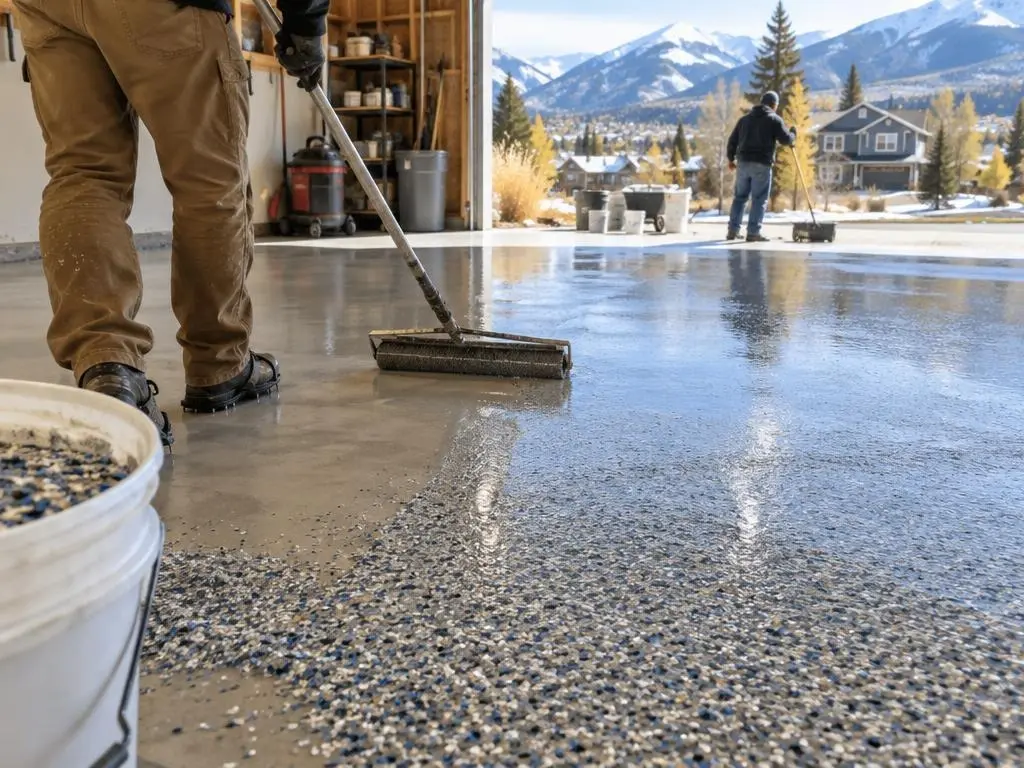
- Flake broadcast floors: colored chips scattered into an epoxy base until it is fully covered, then sealed. Good at hiding sand and dried brine.
- Polyaspartic coatings: fast-curing and UV-stable, so you get the garage back sooner and sunlight through an open door will not yellow it.
- Solid color epoxy: a clean, bright finish for basements, laundry rooms and workshops, with grit added where the floor gets wet.
- Heavy-duty shop systems: thicker coats for equipment, rolling loads and spilled fluids in shops, pole barns and commercial spaces.
- Crack and surface repair: filling cracks, pits and broken joints, and rebuilding flaked areas before anything goes on top.
What a typical garage job involves
- Agreeing on what gets moved out and where it goes
- A moisture check and a close look at cracks, flaking and old finishes
- Diamond grinding the full floor and edges, with dust collected by vacuum
- Filling cracks and pits, and leveling the worst spots by the door
- Base coat, flake or color layer, and a clear protective topcoat
- Written notes on cure times and on keeping the floor clean through winter
Protecting the valley's water
Missoula Public Health describes the Missoula Valley aquifer as an EPA-designated sole-source aquifer and the primary drinking water source for the city. That matters on a floor job. We collect grinding dust with a vacuum, bag it, and keep degreaser rinse and coating waste out of yard drains and the gravel beside the driveway.
Floor Coating Services
Six services for the concrete people around Missoula actually have: sandy garages, older basements, busy shops and slabs that need repair first.
Garage Floor Coating
Ground, repaired and sealed garage slabs that shrug off winter sand, deicer brine and oil drips.
Learn more →Epoxy Flake Floors
Colored vinyl chips locked in resin under a clear coat, a speckled finish that hides road sand and brine haze between washes.
Learn more →Polyaspartic Floor Coating
Fast-curing, UV-stable coatings that return your garage in about a day and handle a wider temperature range than epoxy.
Learn more →Basement Floor Epoxy
Moisture-tested basement and lower-level floors, coated for rec rooms, gyms, laundry and storage.
Learn more →Shop & Commercial Floor Epoxy
Thicker coating systems for shops, pole barns, garages on acreage and commercial floors that take real loads and spills.
Learn more →Concrete Crack & Floor Repair
Filling cracks, rebuilding flaked and pitted concrete, and fixing broken joints, as a standalone job or before a coating.
Learn more →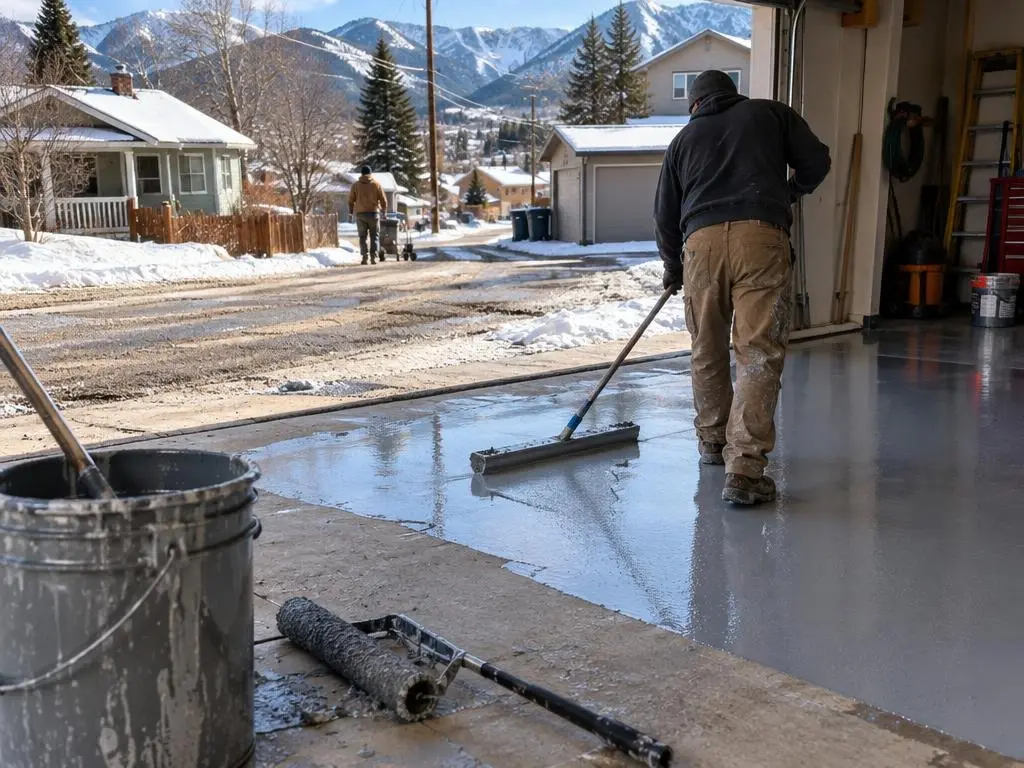
Why Homeowners Call Missoula Epoxy Flooring
We start with the slab
Every floor is diamond ground and repaired before coating. Most peeling traces back to prep that was skipped or rushed.
Moisture tested up front
We check lower-level and slab-on-grade floors before quoting, so the primer and system match the concrete you actually have.
Finishes picked for sand and brine
Garage floors get a hard, chemical-resistant topcoat and enough texture that a wet winter floor is safer to walk on.
A price you can read
The quote lists square footage, prep, each coat and the total. Changes are written up and approved by you before work.
Where We Work
Our work is centered on Missoula. We also coat floors in Orchard Homes, Wye, East Missoula, Bonner-West Riverside, Piltzville and Turah close to town; Lolo, Carlton, Florence, Stevensville and Victor up the Bitterroot; Frenchtown, Huson and Alberton down the Clark Fork to the west; Clinton to the east; and Evaro and Arlee to the north on US 93. Conditions change across that area. Older neighborhoods in town have more detached garages and older basement slabs. Subdivisions on the valley floor tend to have attached garages with newer concrete. Out on acreage in the Bitterroot and along I-90, a lot of the floors we see are in shops and outbuildings, and some sit on gravel roads that are never treated with deicer. Each town page covers what we know about the homes and floors there.
- Epoxy Flooring in Missoula, MT
- Epoxy Flooring in Orchard Homes, MT
- Epoxy Flooring in Wye, MT
- Epoxy Flooring in East Missoula, MT
- Epoxy Flooring in Bonner-West Riverside, MT
- Epoxy Flooring in Piltzville, MT
- Epoxy Flooring in Turah, MT
- Epoxy Flooring in Lolo, MT
- Epoxy Flooring in Carlton, MT
- Epoxy Flooring in Florence, MT
- Epoxy Flooring in Stevensville, MT
- Epoxy Flooring in Victor, MT
- Epoxy Flooring in Frenchtown, MT
- Epoxy Flooring in Huson, MT
- Epoxy Flooring in Alberton, MT
- Epoxy Flooring in Clinton, MT
- Epoxy Flooring in Evaro, MT
- Epoxy Flooring in Arlee, MT
Common Questions
How much does epoxy flooring cost in Missoula?
HomeGuide's national figures put installed epoxy at about $4 to $10 per square foot, or about $1,600 to $5,800 for a two-car garage. Polyaspartic runs about $5 to $12 per square foot. Old coatings, flaking concrete and crack repair add to the total, so we give a written price after seeing the floor.
How much does it cost to epoxy 1,000 square feet?
Using HomeGuide's $4 to $10 range, 1,000 square feet comes to roughly $4,000 to $10,000 for epoxy, and about $5,000 to $12,000 at its polyaspartic range. Where a floor lands depends on prep, repairs and the finish. Large open shop floors can price differently from a garage cut up by steps and corners.
What is the downside of epoxy flooring?
Epoxy needs a dry, clean, ground slab or it can peel. Standard epoxy cures slowly, and HomeGuide notes it can take up to a week to fully cure. It can also amber in sunlight without a UV-stable topcoat, and a glossy finish is slick when wet unless texture is added. We plan for each of those before we start.
Is it expensive to epoxy your floor?
Compared with bare concrete, yes. Compared with replacing a damaged slab, much less: HomeAdvisor lists concrete resurfacing at $1,000 to $5,000 and simple patching at $25 to $250. A coating protects the slab you have. Store kits cost less up front, about $200 to $700 according to HomeGuide, but HomeGuide also says water-based kits may need recoating every 3 to 5 years.
What is better than epoxy for floors?
For many garages, a hybrid system works well: an epoxy base for bonding and build, with a polyaspartic topcoat for UV resistance and abrasion. Full polyaspartic systems cure faster and, per HomeGuide, have a much wider application temperature range. Polished concrete is another option for some shops. The right answer depends on the slab and how you use the space.
Can a garage floor be coated in a Montana winter?
Sometimes. Each product lists a minimum slab and air temperature, and a cold detached garage in January may sit below it. We measure the slab, can heat an enclosed space, and often choose faster-curing polyaspartic materials in cool weather. If conditions are wrong, we schedule for a better window.
Will sand and deicer wear out a coated floor?
They wear it slower than bare concrete, but they do wear it. Grit ground in under tires dulls a topcoat over time, and brine left for weeks leaves a film. Sweeping out sand, squeegeeing meltwater and rinsing a few times each winter keep the floor in good shape.
Get an Epoxy Flooring Estimate
Free on-site estimates in Missoula and the surrounding valleys.